Grade 4
StartRays, vertex and symbol; measuring with non-standard units and a protractor; acute, right, obtuse and straight angles (2018 curriculum).
M.4.2.3.22018 curriculum· translated from TurkishIdentifies the rays and the vertex that form an angle, names the angle and shows it with a symbol.
M.4.2.3.32018 curriculum· translated from TurkishMeasures angles with non-standard units and explains why standard units of measurement are needed.
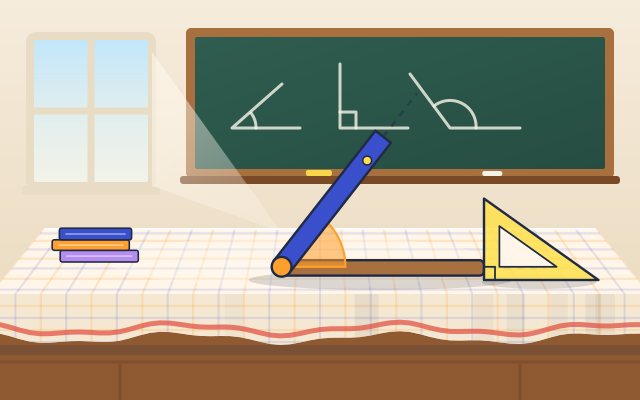
M.4.2.3.42018 curriculum· translated from TurkishMeasures angles with standard angle-measuring tools and identifies them as acute, right, obtuse or straight angles.
- a) Comparisons use the right angle as the reference.
- b) When obtuse angle models are examined, care is taken that they are not larger than a straight angle.
M.4.2.3.52018 curriculum· translated from TurkishConstructs an angle of a given measure using standard angle-measuring tools.
- a) Using angle-measuring tools (protractor, set square, etc.), pupils notice that an angle is formed by turning a ray around its starting point.
- b) It is stressed that angles with the same measure keep that measure whatever their orientation.
Equivalent from 2027–28
MAT.4.3.5Maarif Model 2026· translated from TurkishInterpreting an angle as an amount of turn through everyday examples
- a) Identifies angles through everyday examples.
- b) Turns angles into everyday situations without losing their context.
- c) Restates an angle as an amount of turn.
MAT.4.3.6Maarif Model 2026· translated from TurkishEvaluating the need for standard tools to measure angles
- a) Sets a criterion for measuring angles.
- b) Measures with non-standard units in line with the criterion.
- c) Compares the results obtained with non-standard units against the criterion.
- ç) Judges, from these comparisons, whether standard measuring tools are needed.
MAT.4.3.7Maarif Model 2026· translated from TurkishClassifying angles as acute or obtuse using the right angle as a reference
- a) Identifies the properties of a right angle.
- b) Separates angles into acute and obtuse angles using the right angle as a reference.
- c) Sorts the properties of acute and obtuse angles.
- ç) Names acute and obtuse angles.