Grade 2
StartO'clock, half past, quarter past and quarter to; analog and digital shown together.
MAT.2.1.9Maarif Model 2026· translated from TurkishReading and writing units of time
The lab opens in the version for the grade you choose; grade and language can also be changed inside the lab.
How it works
Here is how the eight steps of the explorer cycle unfold in this lab.
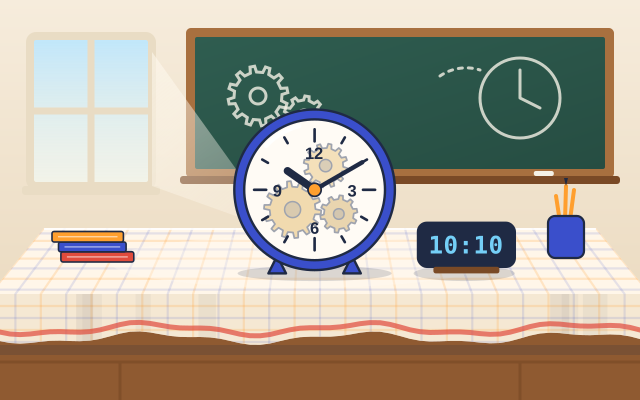
Meets the desk clock, the hour hand, the minute hand, the gears and the digital display.
Shows where the hour hand is in pictures of 3:00 and 3:30.
Thinks about the school bell, break time and how long a cartoon lasts.
Predicts whether the hour hand stays put while the minute hand turns for 60 minutes; the prediction is locked in.
Behind the clear back, the gears turn and the hour hand moves on by one number.
Sees that the hour hand is short and thick and the minute hand long and thin; reads the minute labels.
Does quarter-hour, minute-reading or unit-conversion tasks, depending on the grade.
Picks the clock that shows the time asked for and matches analog and digital times.
Mathematics
Codes and outcomes come from the Turkish national curriculum taught in 2026–27, word for word in Turkish; the English here is our translation of that text, not an official version. Grade 4 follows the 2018 curriculum; its Maarif Model equivalent is shown separately.
O'clock, half past, quarter past and quarter to; analog and digital shown together.
MAT.2.1.9Maarif Model 2026· translated from Turkish
Reading and writing units of time
A 60-mark dial and reading minutes, a Roman-numeral dial, estimating how long events take.
MAT.3.1.12Maarif Model 2026· translated from Turkish
Reading and writing the time on analog and digital clocks
MAT.3.1.13Maarif Model 2026· translated from Turkish
Analyzing units of time
MAT.3.1.14Maarif Model 2026· translated from Turkish
Estimating how long events take and making judgments about it
Relationships between hours, minutes, seconds and days; time problems (2018 curriculum).
M.4.3.4.12018 curriculum· translated from Turkish
Explains the relationships between units of time.
M.4.3.4.22018 curriculum· translated from Turkish
Solves problems involving units of time.
This lab is mapped to learning outcomes M.4.3.4.1 and M.4.3.4.2 of the Turkish Ministry of National Education's 2018 Mathematics curriculum. It has not been reviewed or approved by the Ministry of National Education (MEB) or its Board of Education (TTKB).
This lab is mapped to learning outcomes MAT.2.1.9, MAT.3.1.12, MAT.3.1.13 and MAT.3.1.14 of the Turkish Ministry of National Education's Türkiye Century Maarif Model Mathematics curriculum (2026 version). It has not been reviewed or approved by the Ministry of National Education (MEB) or its Board of Education (TTKB).
For teachers
Children see that the hour and minute hands move together, and read and write the time on analog and digital clocks.
When the minute hand goes all the way round, where is the hour hand?
Children show their choice with their fingers and you count. Then you watch the result together.
“The minute hand is on 4, so it's 4 minutes past.”
“The minute hand is on 4, so it's 20 minutes past: each number is 5 minutes.”
Two pupils stand back to back in the middle of a clock face on the floor: one is the short hour hand, the other the long minute hand. As the minute hand goes all the way round, the hour hand moves on one number, and the class says the time.
You need
There is no grade 1 version (the Maarif Model has no clock reading in grade 1). The grade 4 version follows the 2018 curriculum.